

2026 Monarca Democracy Defense Toolkit
Our democracy is under attack. The stakes could not be higher - either we save our democracy, or we don't. Defending and strengthening our democracy under current conditions requires us to prepare now and take action before, during, and after elections.
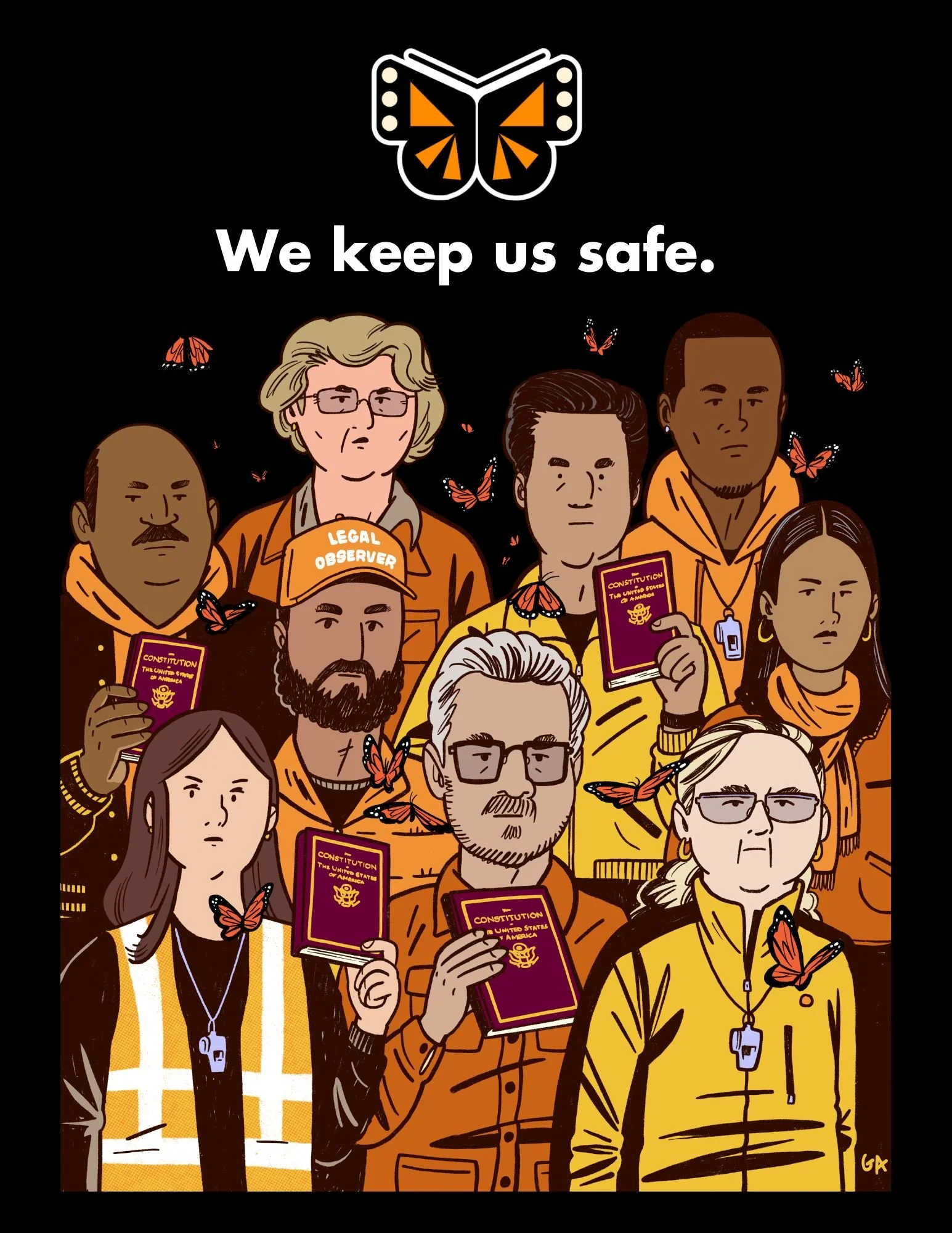
Resources
Door knocking resources:
Info leave-behinds: English || Spanish
Sample agenda (hosting your own event)
During the election season
Voter engagement and poll defense.
After the election
Defend the election results.
Work together to deliver an agenda with material wins for Minnesota’s working families, and building a world with safety and dignity for all.
Before the election season
Build out a strong Democracy Defense Network.
Secure our right to vote.
Protect Our Vote: How to Take Action

-
Bring at least 30 community members to a city council or county board meeting and ask local officials to publicly commit to protecting free and fair elections.
Your group will:
Speak during public comment.
Ask election officials how they are preparing for possible interference.
Show support for election workers who follow the law.
Invite more people to help defend the election.
Local officials manage voter records, polling places, ballot counting, and election results.
Public meetings give residents a direct way to support them and hold them accountable. We’re showing up to hold our elected accountable: What are they doing to protect our right to vote and have it counted.
-
Our freedom to vote, and to have every eligible vote counted, is under threat.
Federal officials have sought voter records, access to election equipment, and investigations into claims that courts and bipartisan reviews have already rejected. These actions can create confusion, intimidate election workers, and make it harder for eligible voters, especially Black, immigrant, and working-class communities, to participate.
When we organize publicly, we make it clear that our communities are watching and will defend every voter.
-
Organize at least 30 people to attend a city council or county board meeting with public comment.
During the meeting, community members will:
Explain why protecting the election matters.
Ask what local officials are doing to prevent interference.
Ask officials to follow state election laws and protect eligible voters.
For a larger city or county, set a higher turnout goal.
The Constitution gives states the authority to carry out their own elections, and elected officials do the actual work in cities and counties. Typically, elected officials are city or county clerks, registrars, or a board of elections. These are community members who are responsible for maintaining voter registration records, run poling places, oversee ballot counting, and help certify results. Because they hold this power, they are likely to be targets of interference, intimidation, harassments, baseless investiongations and even lawsuits. We want these elected officials to know that we support them and we will hold them accountable to protecting our right to vote and have it counted. Follow the guide below to lead your action:
Step 1: Schedule your meeting
To ensure our elected officials know this, we invite you to lead a community action at your local city council or commission meeting with public comment and ask them what they are doing to protect our rights to vote and have it counted.
First, check your county’s website or call the clerk office to confirm details for the next meeting with public comment. Schedule your action for a meeting by the middle of August.
Some information to consider:
Meeting date, time, and location
Public-comment rules
Speaker registration deadline
Speaking time limit
Accessibility and interpretation options
Whether signs are allowed
Whether the meeting is livestreamed (you can share a recap of the event with anyone who might have missed it or be intersted in participating in a future meeting)
Step 2: Build your leadership team
Remember, it takes a village to pull off a successful action. Don’t organize this action alone. Invite or proposition 2-3 leaders to co-lead the action with you and share responsibilities.
Actions to be distributed:
People turnout (each person should be responsible for bringing at least 10 people. Consider your overall turnout goals.)
Prepare speakers (who will testify? who will support them through the process?)
Handle signs and logistics (will you bring signs? who will reminder emails? who will answer questions at the event?)
Take pictures during the event to help amplify your action (who will take pictures? what social media platforms can you share a recap of your event?)
Step 3: Invite your community
Aim to bring at least 30 people to your action. If you live in a higher density city or county, consider bringing at least 70 people.
Make a list of people you can invite, including neighbors, friends, coworkers, and coalition partners (faith, labor, student, local groups, etc).
Personal invitations work better than a social media invites or a flyer. Personally reach out to each person on your list and share 2-3 reasons elections are important/why they matter to you, then ask them to join you.
Sample invitation you can make your own:
Hi [name].
I’m reaching out because our freedom to vote and have every vote counted is under threat. I am coordinating an action to bring community members to the next city council or county board meeting on [your meeeting date] to ask local officials how they will protect voters and stand against unlawful interference. We want to show that our community is paying attention. Can I count on you to attend?If yes, send them the meeting date, time, location and any other arrival instructions necesssary.
If not, thank them and invite them to reach out if they want to be part of a future action.
Step 4: Prepare for the meeting
Choose several people to speak during public comment. Speakers should represent different parts of the community and each person should focus on one message. Public comments should be brief, personal, and respectful. Keep your message under 3 minutes long. You can customize the outline below to make it more personal:
Hi, my name is [your name] and I live in [your city or county]. No matter our race, income, neighborhood, or political party, every eligible voter should be able to vote and have their ballot counted. Our community is concerned about efforts to obtain voter information, interfere with local election systems, or pressure officials to ignore election laws. What is our city or county doing to protect voters, election workers, voter information, and the fair certification of results? We are asking you to commit to: Follow state election laws, protect voters and voter information, reject unlawful interference, count every lawful ballot, and certify the lawful election results
Democracy Defense Ladder
-
May - August
Every zone leader will talk with people on their block or in their building or congregation about:
The opportunity to tell a story with the Truth Council
Voter registration
The option to participate in democracy defense
Toolkit:
Instructions for talking with neighbors
June - September
Truth Council Story Actions:
Get trained to collect stories
Events: Learn more about actions at our Monthly Zoom events at monarcan.og/actions
-
August
September
Every zone leader will talk with people about early voting and scenario planning events
July - November
Electoral Engagement Action Options
Get people out to vote
Build relationships with county officials to ensure they will certify election results
Prepare to support people at the polls with
Rides
Legal observers
Election judges
Events: Learn more about actions at our Monthly Zoom events at monarcamn.org/actions
-
September
Every zone leader will invite people to participate in local scenario planning events.
Ongoing
Results Protection Action Options
Corporate Accountability: Demand corporations speak out in favor of free and fair elections
Form: Business for Democracy Pledge
Event: Corporate Campaign Action Planning on May 26
June 2026 - January 2027
Scenario event planning: At the June 27th Scenario planning training, we will dig into potential scenarios to learn and prepare for what may come. After the training, you can choose to learn to host a scenario planning training within your network:
If they take our voter rolls
If they refuse to hold elections
If they refuse to certify the results
Events: On June 27 attend a in-depth scenario planning event, with the option to prepare to lead one in your neighborhood or congregation
Learn more about actions and other upcoming events at our Monthly Zoom events at monarcamn.org/actions
-
November 2026
Every zone leaders will invite people to share what they want to change and participate in moving policy in November
January 2027
Move Our Agenda Action Options
Policy liaison:
Make sure people in your network are talking to neighbors about what they want
Bring people together to pass policies that support safety and dignity for all, for example
Healthcare for all
Immigration reform
Affordable clean energy
Events: Learn more about actions and other upcoming events at our Monthly Zoom events at monarcamn.org/actions
Host a Democracy Defense Training
-
Talk to people who can co-host training with you
Tools:
Script: Invitation
Link: See if a training has been scheduled near your area here
Request a Monarca Democracy Defense Training for May-July
Tools:
Take a look at trainings that have already been scheduled here
Speak with Monarca Democracy Defense team to confirm that a trainer is available for that date and location, and talk about reaching your invite goal
Someone will reach out. For questions, contact info@monarcamn.org
Make a list of people you know, make invites (goal 35+ in suburban or rural areas, 70+ in urban areas)
Tools:
Script: Invitation
Host training and make a plan to build your network, block by block
Tools:
Training Workbook: Making a Plan
-
Form groups of 5-10 people in your neighborhood/congregation and define the area you will take responsibility for
Tools:
Training Workbook: Training Instructions
Link: See if there are existing networks in your area
Choose people from your network to learn about actions within one of the four Democracy Defense Ladder areas of interest
Tools:
Events: Learn more about actions at our Monthly Zoom events at monarcamn.org/actions
Fill out the Democracy Defense Pledge with your network name and boundaries, and commitments
Form: Democracy Defense Pledge
Network leaders - we will create a spreadsheet for your network, where we will add new people in your area who would like to connect
Stay in contact with an Unidos organizer
Someone will reach out. For q’s contact info@unidos.org
-
Two weeks after your training, meet with your team and the potential new zone leaders you have invited
Tools:
Two weeks after 1st network meeting, host a second Monarca Democracy Defense Training (as needed) to complete your network
Tools:
-
After your network is built, begin to engage neighbors on the Democracy Defense Ladder (find more information on each step below):
Truth Council Stories
Electoral Engagement
Election Results Protection
Move Our Agenda
Training Invitation Scripts
-
Neighborhood Script
-
Congregational Script